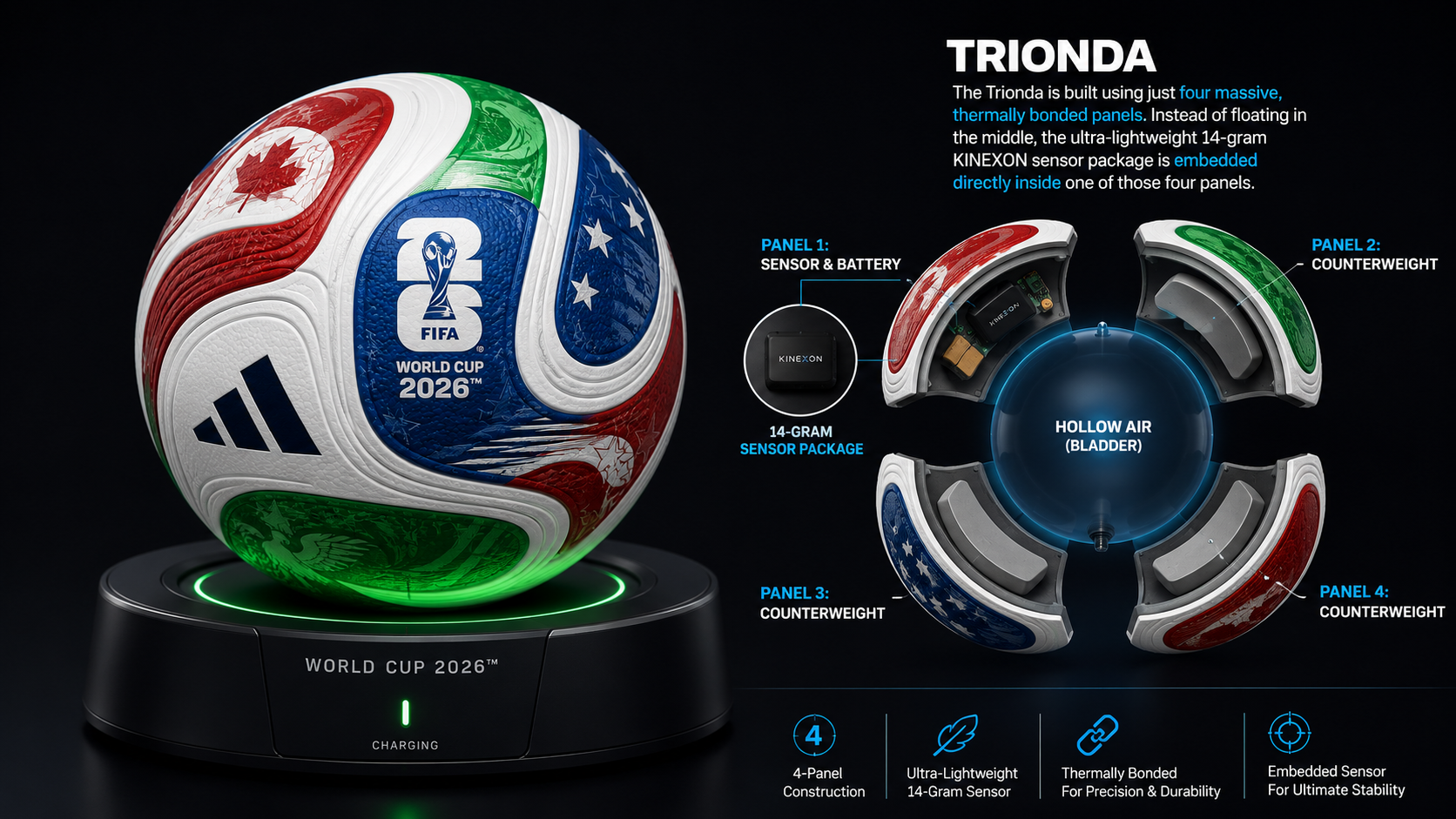
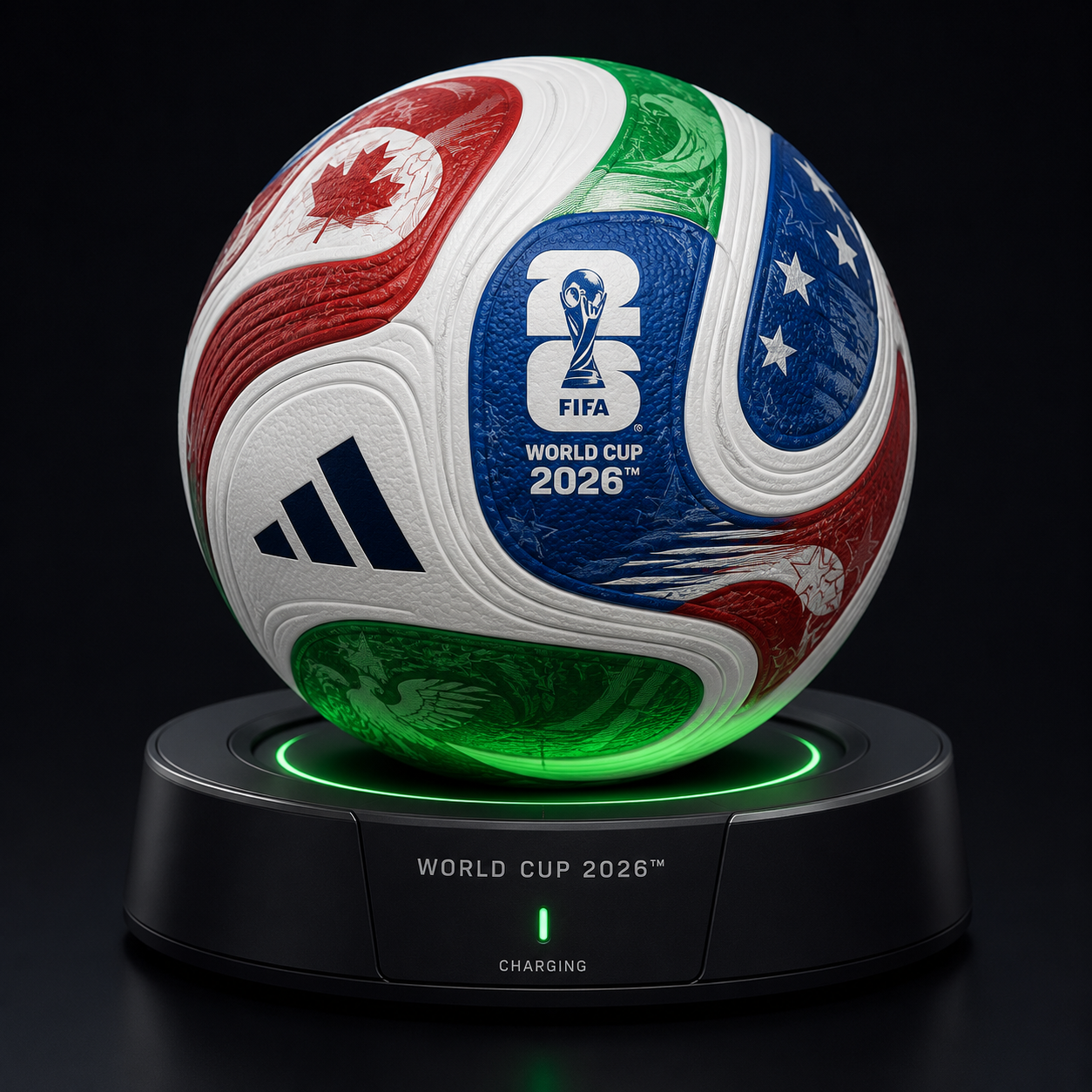
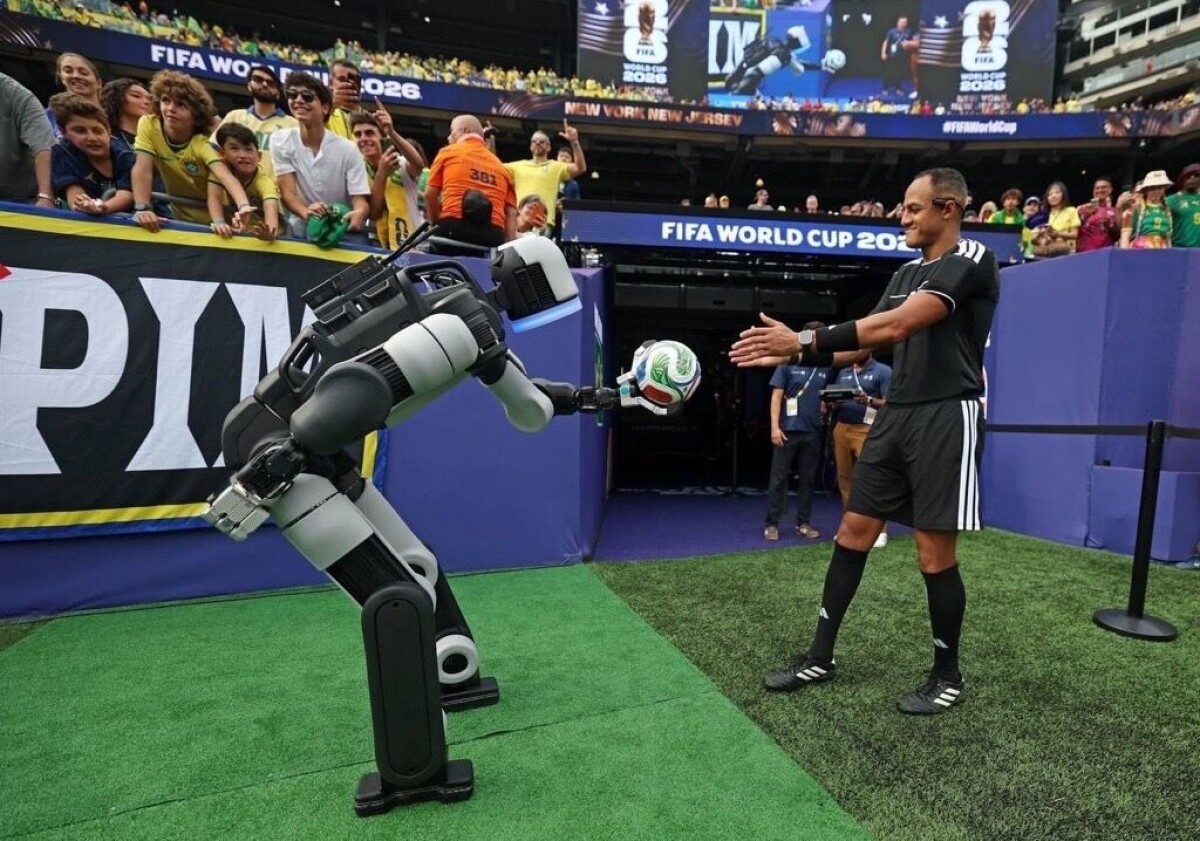
 If you peeked into the referee locker rooms at the 2026 FIFA World Cup you would see something strange: a rack of Adidas Trionda match balls plugged into electrical outlets like a row of smartphones.
It looks like a tech parody. But it is entirely real. The football on the pitch now has a battery life, a processor and a very specific job to do. Here is how the world's most famous sports equipment became a piece of smart technology.
What Is the Trionda?
The Adidas Trionda is the official match ball of the 2026 FIFA World Cup hosted by Canada, Mexico and the United States. It was unveiled on October 2 2025 and introduced during the tournament in June 2026.
The name comes from two Spanish words: Tri meaning three and Onda meaning wave. The red, green and blue design is a nod to the three host nations. But what makes it genuinely different from any World Cup ball before it has nothing to do with how it looks.
|
The Tech Inside: What Is a Smart Ball?
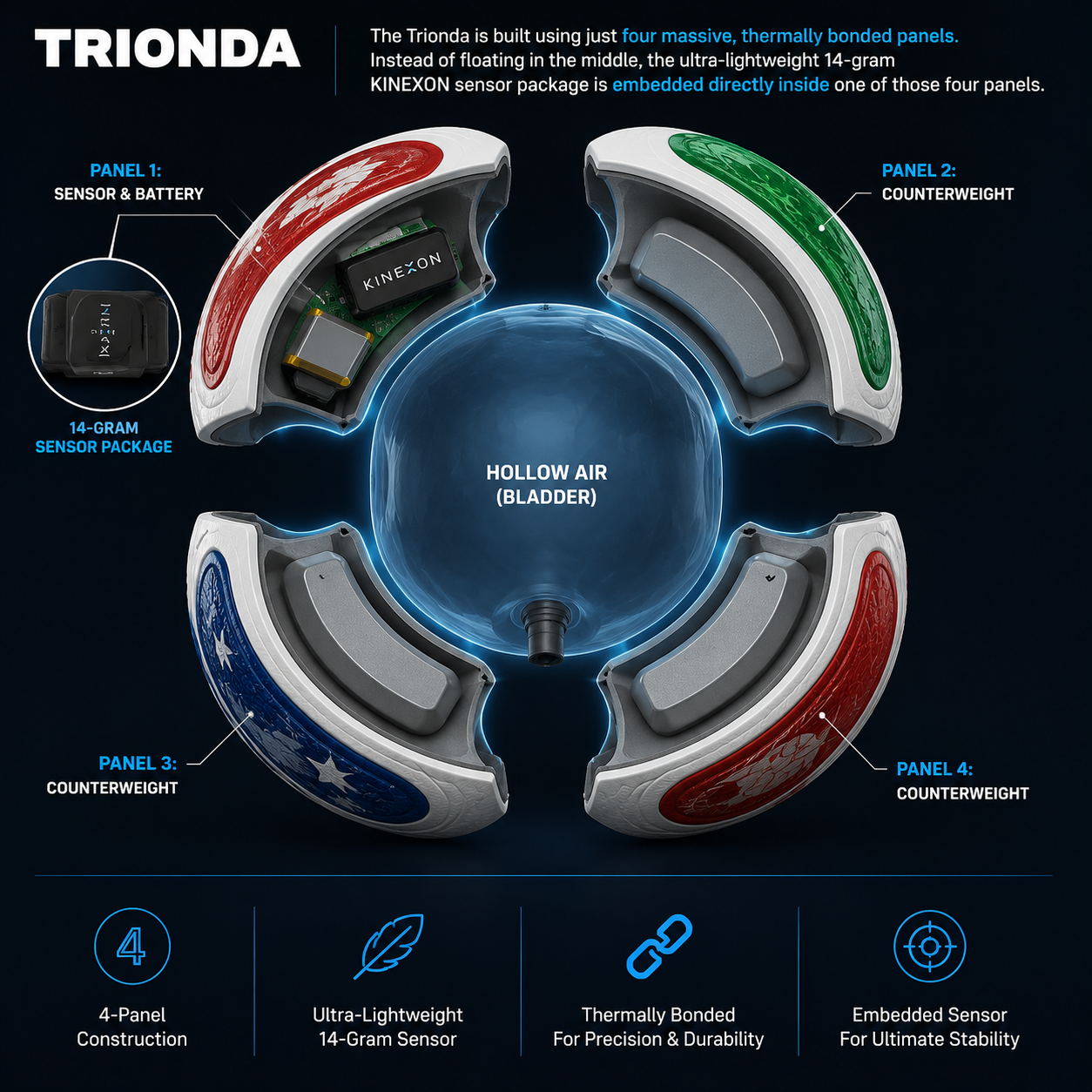
Inside one of the Trionda's four panels sits a side-mounted 500Hz Inertial Measurement Unit (IMU) sensor chip developed in partnership between Adidas, FIFA and Munich-based sports tech firm KINEXON.
"Live ball tracking currently enhances real-time exercises and game analysis, live performance assessments and creates new marketing opportunities. Additionally the solution provides referees with vital information about ball touch events." Daniel Linke, Product Strategy Lead at KINEXON Sports |
This is a notable engineering change from the previous World Cup ball, the Al Rihla used at Qatar 2022, where the sensor was suspended at the centre of the ball inside the bladder. The Trionda moves the sensor to the side of one panel with counterweights built into the three remaining panels to maintain flight balance despite the off-centre positioning.
Here is what the sensor actually does:
• 500 times per second: The sensor broadcasts location and motion data 500 times every second. Standard broadcast cameras typically capture 25 to 60 frames per second. The ball's sensor is 8 to 20 times more granular than what you see on your television screen.
• Three-dimensional tracking: The IMU measures movement across three dimensions tracking speed, spin, trajectory and distance in real time throughout the entire match.
• Instant impact detection: The sensor detects the exact microsecond a boot, glove or head makes contact with the ball. This is the data point that VAR uses to judge offsides.
• Ultra-lightweight: The entire sensor unit weighs just a few grams. Players cannot feel any difference in how the ball flies or handles.
Why Does It Need to Be Charged?
Data transmission requires power. The internal sensor runs on a rechargeable lithium battery. Before every match all balls must be fully charged. A single charge provides approximately six hours of active tracking data which comfortably covers a 90-minute match plus extra time.
When a ball sits on the sideline or in storage it automatically enters a low-power sleep mode to preserve battery life until it is back in play. This is why you might see a referee swap a ball mid-match and send it back to the technical area. It may not be losing air pressure. It may just need to go back on the charger.
The Charging Setup Every stadium at the 2026 World Cup has a dedicated ball-charging station in the match officials' preparation area. Multiple balls are kept charged and ready throughout the tournament. Adidas has not publicly disclosed the full technical specifications of the battery but has confirmed the six-hour active tracking duration. |
How It Works With VAR
The smart ball does not work alone. It transmits data to a network of specialized tracking cameras mounted around each stadium. The sensor and cameras work together to solve two of football's most debated problems:
|
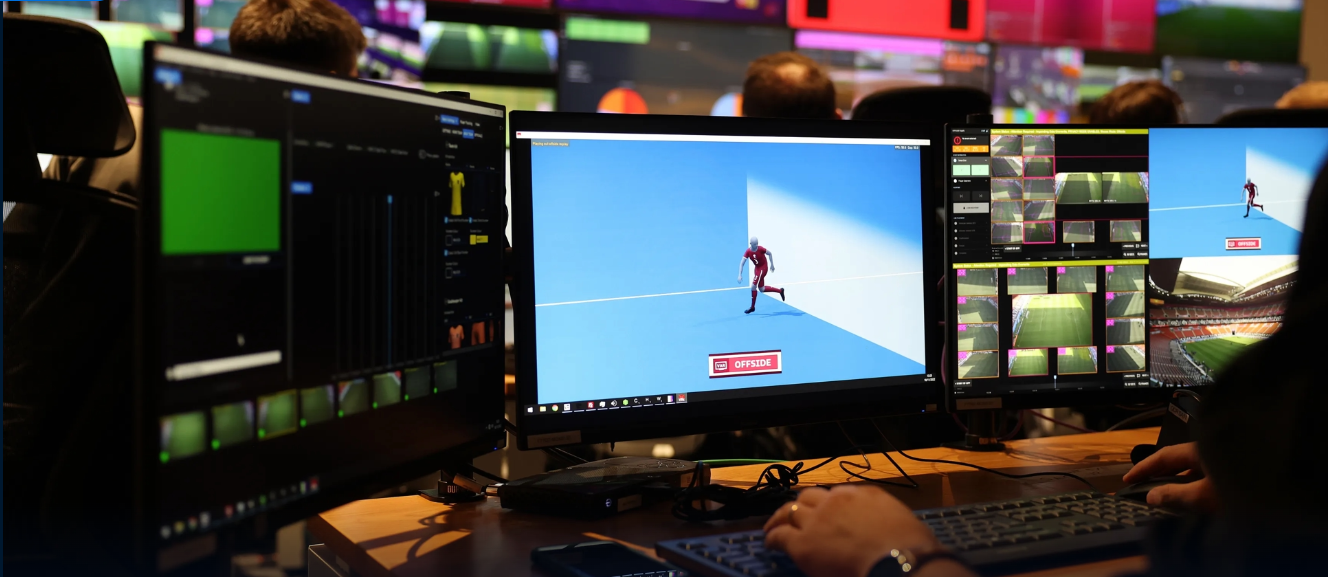
• Offside accuracy: VAR officials need to know the exact frame when the passing player kicked the ball to judge offsides correctly. Previously human operators paused video manually which introduced millisecond errors. The Trionda's sensor identifies the exact microsecond of the kick automatically giving VAR a precise baseline for every offside review.
• Goal-line and out-of-bounds decisions: Did the entire ball cross the line? Was it a corner or a goal kick? By combining the ball's internal position data with stadium cameras the system can determine ball position to within millimeters. No more guesswork.
• Handball detection: The Trionda sensor also helps identify handball incidents by detecting the type of contact made with the ball. Kick, header, handball and deflection all produce different impact signatures that the IMU can differentiate.
During the early stages of the 2026 World Cup in mid-June VAR officials used sensor data from the Trionda to accurately overturn an offside call, one of the first confirmed instances of the technology directly affecting a match outcome.
The Future of Football Data
The smart ball is not just changing how referees work. It is reshaping what broadcasters and clubs can do with football data:
• Shot velocity displayed in real time on screen during live broadcasts
• Spin rate of curling free kicks measured in RPM
• Passing distance tracked live throughout the match
• Contact type data to support faster handball and foul decisions
For clubs the data creates a new layer of performance analysis. Coaches can now review exact ball physics from every touch in a match rather than relying on camera angles alone. In time this data will feed directly into player development systems, tactical planning and opposition analysis.
Just like FIFA, modern businesses need to embed smart data into their everyday tools. Contact us to see how we build data-driven software for your company.
We build smart software for African businesses. The same real-time thinking. Different pitch. info@waverontechnologies.co.ke | waverontechnologies.co.ke | Nairobi Kenya Innovation's Crest. Tomorrow's Best. |



Comments (0)
No comments yet. Be the first to share your thoughts!